
Charleston Regional Development Alliance

Berkeley, Charleston & Dorchester Counties

Printed from www.crda.org

Fast-Growing Talent Pool

Employers seeking the best and brightest find a growing pool of skilled talent in the Charleston region. This market is experiencing exploding growth in knowledge-based occupations at rates better than the state's and nation's. A burgeoning technology sector is building a strong base of technically skilled workers, especially in the areas of engineering and information technology.

related information

Employment StatisticsEmployment GrowthWage StatisticsUnionization RateWorkforce Training & Development

Charleston S.C. MSA Workforce & Employment Profile

Workforce Statistics 
Civilian Workforce1 2000 2011 % Change Forecast 2012 Forecast 2013
Labor Force 268,196 328,688 22.6% 330,700 333,000
Employed 259,792 291,941 12.4% 296,104 300,546
Unemployed 8,404 300,915 - 25,271 24,517
Unemployment Rate (%) 3.1% 8.4% - 7.6% 7.4%
Expanded Labor Pool2 2000 2010
Commuters into MSA 10,778 -
Commuters out of MSA 8,360 -
Underemployed Workers, expanded labor shed3 - 112,900
Annual High School Graduates - 4,865
Annual Post-Secondary Degrees Conferred - 6,500


Employment by Industry
NAICS Sectors4 2011 Total Employment 2011 % of Total Employment % Change 2009-2011 % Change 2000-2011
Natural Resources, Mining & Construction  13,500 4.7% -3.6% -31.5%
Manufacturing 21,900 7.6% 5.3% -4.4%
Trade, Transportation & Utilities  54,900 19.1% 3.2% 0.5%
Information 5,000 1.7% -2.0% 8.7%
Financial Activities 12,100 4.2% -0.8% 8.0%
Professional & Business Services  42,240 14.7% 3.5% 32.0%
Education & Health Services 33,400 11.6% 2.1% 41.5%
Leisure and Hospitality 35,900 12.5% 2.0% 15.8%
Other Services 10,500 3.7% -0.9% 10.5%
Government 57,950 20.2% -1.3% 15.4%
Total Nonagricultural Employment 287,350 100.0% 1.5% 10.8%


Employment & Wages by Occupation
Occupation Title5 2011 Total Employment 2011% Total Employment % Change 2000-2011 2011 Avg Hourly Wage ($) 2011 Median Hourly Wage ($)
All Occupations 285,060 100.0% 21.6% 19.64 15.59
Management 13,360 4.7% -16.4% 46.50 40.14
Business and Financial Operations 10,930 3.8% 54.6% 29.51 27.06
Computer and Mathematical Science 6,060 2.1% 91.8% 31.59 30.35
Architecture and Engineering Occupations 7,550 2.6% 79.8% 32.63 31.08
Life, Physical, and Social Science 1,860 0.7% 1.1% 27.99 24.95
Community and Social Services 2,980 1.0% 14.2% 19.08 17.13
Legal 2,050 0.7% 29.7% 38.43 25.68
Education, Training and Library 14,490 5.1% -2.6% 21.39 20.97
Arts, Design, Entertainment, Sports and Media 2,630 0.9% 40.6% 22.49 18.08
Healthcare Practitioner & Technical 21,460 7.5% 67.1% 31.82 28.11
Healthcare Support  7,650 2.7% 38.3% 13.29 12.29
Protective Service 7,360 2.6% 28.4% 16.45 15.62
Food Preparation and Service Related 28,740 10.1% 26.7% 10.13 8.95
Building and Grounds Cleaning and Maintenance 10,680 3.7% 8.5% 10.78 9.28
Personal Care and Service 8,100 2.8% 68.4% 11.83 9.87
Sales and Related 31,970 11.2% 32.5% 14.96 11.20
Office and Administrative Support 49,470 17.4% 38.7% 15.45 14.37
Farming, Fishing and Forestry 140 0.05% -46.2% 14.47 14.20
Construction and Extraction 10,610 3.7% -25.6% 17.48 16.28
Installation, Maintenance and Repair 12,580 4.4% 10.6% 19.32 18.60
Production 16,320 5.7% 4.4% 18.56 17.29
Transportation and Material Moving 18,050 6.3% -2.2% 15.25 13.12


Notes & Sources:
(1) U.S. Bureau of Labor Statistics; Forecast data from Center for Business Research, Charleston Metro Chamber of Commerce 6/2012.
(2) 2000 Census, U.S. Census Bureau (latest available); S.C. Dept of Education; S.C. Commission on Higher Education, 2012.
(3) Pathfinders study 2009; Charleston S.C. labor shed includes metropolitan counties of Berkeley, Charleston and Dorchester plus neighboring Colleton, Clarendon and Orangeburg, and portions of Georgetown and Williamsburg.
(4) U.S. Bureau of Labor Statistics, Current Employment Statistics (CES); NAICS = North American Industry Classification System, 6/2012
(5) U.S. Bureau of Labor Statistics, Wages & Employment By Occupation Survey 2011, released 6/2012.

Highly Skilled & Available

Charleston area businesses draw upon a diverse and ever-deepening pool of talent comprised of:
  • New skilled labor. Steady streams of new workers are relocating to the region.
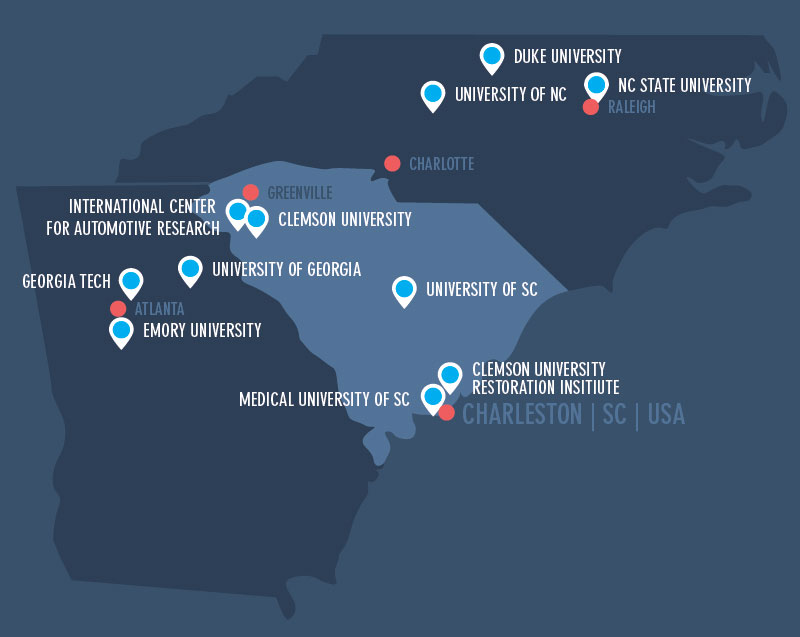
  • Local college graduates. Nearly 7,000 degrees are awarded locally each year.
  • Commuters. Nearly 11,000 residents from surrounding counties commute into the Charleston region to work.
  • The military. More than 18,000 military retirees live in the area, with most continuing their careers in the private sector.


Civilian Workforce Growth Rates 2000-2011

  Charleston S.C. MSA  South Carolina  United States 
Labor Force Growth Rate 22.6% 8.5% 7.7%
Employment Growth Rate 15.8% 1.0% 2.2%
Source: U.S. Bureau of Labor Statistics, 6/2012


Underemployment

According to a 2009 workforce assessment study, conducted by an independent national consultant group, approximately 112,900 workers in the Charleston region can be defined as "underemployed." Contact Hank Taylor, V.P. Global Business Development at 843.760.4526, at the Charleston Regional Development Alliance for the full report.

2011 Charleston S.C. MSA Wages by Occupation

Occupation Title  Hourly Average  Annual Average  Hourly Median  Annual Median 
All Occupations $19.64 $40,850 $15.59 $32,427
Architecture & Engineering $32.63 $67,870 $31.08 $64,646
Arts, Design, Entertainment, Sports & Media $22.49 $46,790 $18.08 $37,606
Building & Grounds Cleaning / Maintenance $10.78 $22,430 $9.28 $19,302
Business & Financial Operations $29.51 $61,380 $27.06 $56,285
Community & Social Services $19.08 $39,680 $17.13 $35,630
Computer & Mathematical $31.59 $65,700 $30.35 $63,128
Construction & Extraction $17.48 $36,350 $16.28 $33,862
Education, Training & Library $21.39 $44,490 $20.97 $43,618
Farming, Fishing & Forestry $14.47 $30,090 $14.20 $29,536
Food Preparation & Serving Related $10.13 $21,080 $8.95 $18,616
Healthcare Practitioners & Technical $31.82 $66,200 $28.11 $58,469
Healthcare Support $13.29 $27,640 $12.29 $25,563
Installation, Maintenance & Repair $19.32 $40,190 $18.60 $38,688
Legal $38.43 $79,930 $25.68 $53,414
Life, Physical & Social Science $27.99 $58,220 $24.95 $51,896
Management $46.50 $96,710 $40.14 $83,491
Office & Administrative Support $15.45 $32,140 $14.37 $29,890
Personal Care & Service $11.83 $24,600 $9.87 $20,530
Production $18.56 $38,610 $17.29 $35,963
Protective Service $16.45 $34,210 $15.62 $32,490
Sales & Related $14.96 $31,120 $11.20 $23,296
Transportation & Material Moving $15.25 $31,710 $13.12 $27,290
Source: U.S. Bureau of Labor Statistics, 6/2012.

2012 Unionization Rate

  Unionization Rate 
Charleston S.C. MSA 1.9%
United States 11.3%
Source: Center for Business Research, Charleston Metro Chamber of Commerce, and US Bureau of Labor Statistics, 2/2013. South Carolina is a right-to-work state.

Workforce Training / Development

South Carolina helps fund workforce training needs through three major options:

Customized training through readySC

  • A state-funded program, readySC is provided at little or no cost to companies creating new jobs with competitive wages and benefits.
  • The program offers customized recruitment, assessment, training development, management and implementation services to qualifying companies.
  • An integral part of the S.C. Technical College System, readySC provides a pre-trained and productive workforce from the first day of operations.

Workforce Investment Act (WIA) employment and training services

  • Provided through the Trident One-Stop Career System, a public-private partnership offering employment-related services to both job seekers and employers.
  • The System operates one-stop centers in Berkeley, Charleston and Dorchester counties, and has facilities and meeting spaces available to area businesses to assist with training sessions, recruitment events, business seminars, small to medium conferences, career fairs, and pre-hire and post-hire testing sessions.
  • The System also provides services to help eliminate or reduce the costs of employee recruitment, screening and testing, such as WorkKeys®.
  • Both on-the-job and classroom programs are available.

Existing industry retraining funds

  • South Carolina supports existing companies by offsetting a portion of the cost associated with the retraining of qualifying employees.
  • The retraining must be approved and coordinated by our local technical college under the jurisdiction of the State Board for Technical and Comprehensive Education.
  • Companies may be reimbursed up to $500 per employee per year (not to exceed $2,000 per employee over five years).
  • To qualify, companies must match on a dollar-for-dollar basis.
  • An application to the Coordinating Council for Economic Development is required for consideration ($500 application fee).