Charleston's Competitive Advantages
The Charleston region offers several competitive advantages: university-based research, engineering and supercomputing capabilities; a strong existing manufacturing cluster and renewable energy industry; and a deepwater port. In addition, the continued development of the region's aerospace industry will provide complementary and non-competing capabilities in composites, logistics, electronics and other related areas of expertise.
The
Clemson University Restoration Institute (CURI)
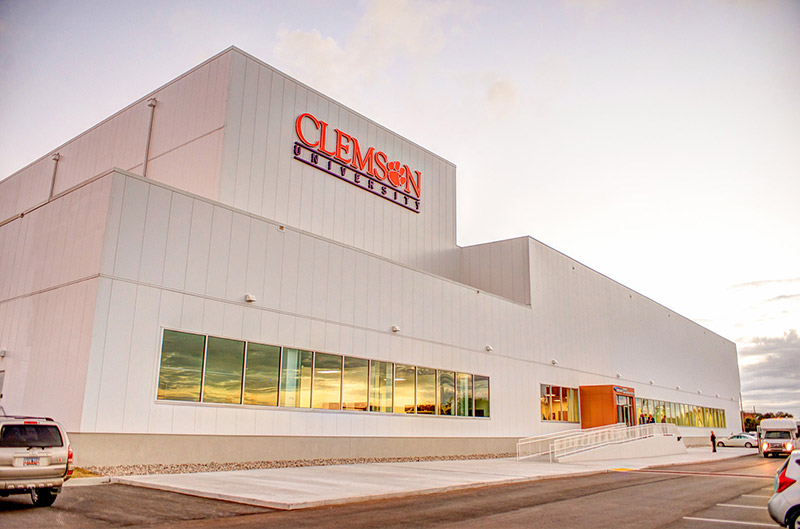
was established in 2004 to drive economic growth by creating, developing and fostering restoration industries and environmentally sustainable technologies in South Carolina.
CURI is strategically located on a
97-acre research campus
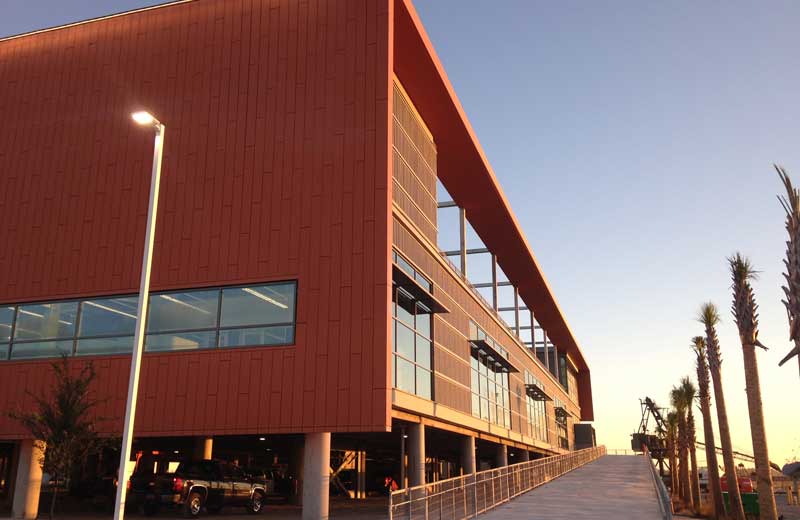
at the Charleston Naval Shipyard, a working port facility on the East Coast offering worldwide access to wind turbine innovators through ship, rail or road. Anchored by the offshore wind turbine drivetrain testing facility and the graduate engineering center, CURI's campus will become a hub for energy systems testing.
With materials conservation and research already underway at the
Warren Lasch Conservation Center
, the campus also will include research in materials manufacturing, large bearing testing, lubrication and tribology.
A graduate engineering center will become a landmark building where students, Clemson University faculty and staff, and industry partners will collaborate.
CURI pairs North Charleston's materials manufacturing and assembly process with Charleston's heritage as the nation's leading living laboratory for cultural and structural preservation. It brings together experts and researchers in six focus areas: renewable and alternative energy, restoration ecology, advanced materials, resilient infrastructure, community revitalization and historic preservation.
World's Largest Wind Turbine Drivetrain Testing Facility
CURI is currently constructing the
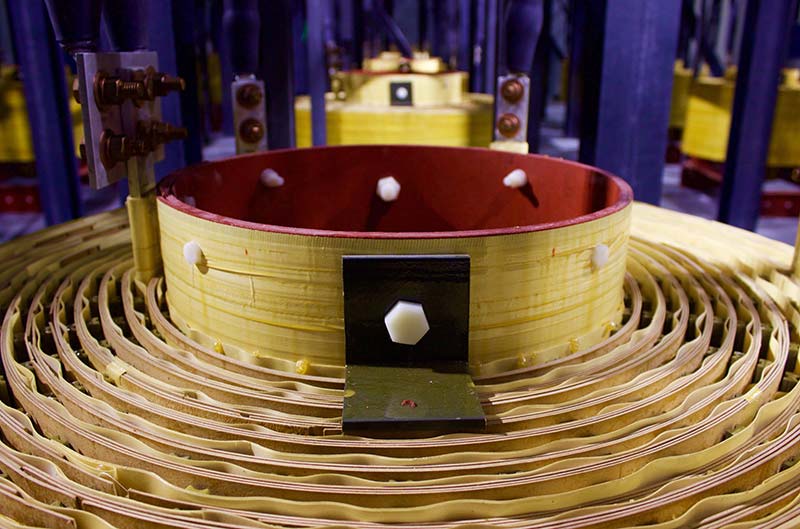
Wind Turbine Drivetrain Testing Facility (WTDTF)
as part of a growing energy R&D complex. One of only three such facilities in the world and the largest, it will be fully operational by the end of 2012.
The global leaders in wind turbine manufacturing serve on the Industrial Advisory Board for the Center with the key industry players already requesting time in the facility for testing their next generation turbines.
CURI offers deepwater access, is adjacent to the Port of Charleston and will be capable of full-scale advanced testing of next-generation drivetrain systems up to 15MW and 7.5MW with dynamic non-torque loading, as well as 50Hz or 60Hz testing.
While it is the world's largest quality control center for offshore wind turbines, it will accommodate other industries as well, including aerospace and automotive, which have similar composite needs as the wind industry.
Additional Restoration Research and Expertise
The emphasis in Advanced Materials and Energy Systems builds on Clemson University's core competencies in multi-body modeling, advanced materials, systems engineering, power systems engineering, sensors and sustainable environment.
-
Advanced Materials, Processes, and Systems: The Charleston region is a hub for composites-based assembly; this work focuses on developing new methods and materials to lessen demand on these finite resources
-
Submerged Metals: Scientists have developed advanced engineering techniques to remove and prevent corrosion on saltwater-exposed metal surfaces
-
Restoration Ecology: The Intelligent River - Linking Water Resources, Land Use, Energy and Climate Change through observation systems to support research and provide real-time monitoring, analysis and management
Integrated, Global Infrastructure
The
Port of Charleston
is the most efficient and eighth-busiest U.S. seaport, with five terminals close to the open sea. This deepwater Port expertly handles breakbulk, project and heavy lift cargoes up to 500 tons with on-dock rail, excellent oversize clearances inland, and ample open or covered storage.
It is also currently and efficiently handling fully-loaded Post-Panamax vessels up to 8,000 TEUs.
Charleston offers dual rail access, linkage to multiple Interstates via I-26, and a convenient
international airport
with direct domestic flights to major cities and quick connections to nearby international hubs.
Skilled Workforce and Talent
Charleston's skilled manufacturing workforce grew more than 5% between 2000 and 2009 compared to a 28% decline for the United States during the same period.
Charleston offers comprehensive workforce training developed and delivered by South Carolina's internationally recognized pre-employment training program,
readySC
, which develops a trained workforce at little or no cost to companies.
Trident Technical College
also collaborates with local companies to develop customized programs.
Competitive Wage Structure
The chart below provides wages typically associated with the renewable energy sector, or visit our
workforce and employment page
to access a more comprehensive list of average wages by occupation (BLS data).
For a local wage & benefit survey broken down by industry sector and company size contact Hank Taylor, V.P. Global Business Development, at 843.760.4526 or
htaylor@crda.org
, at the Charleston Regional Development Alliance
Energy Systems Cluster, Selected Occupations, Charleston S.C. MSA
| Occupation Code |
Occupation Title |
2011 Average Hourly Wage |
2011 Median
Hourly Wage |
Employment |
Location Quotient* |
| 11-1021 |
General & Operations Managers |
$52.74 |
$44.26 |
3,930 |
0.98 |
| 17-2051 |
Civil Engineers |
$32.19 |
$30.37 |
1040 |
1.84 |
| 17-3022 |
Civil Engineering Technicians |
$18.23 |
$18.43 |
130 |
0.8 |
| 17-2071 |
Electrical Engineers |
$38.72 |
$38.20 |
330 |
0.96 |
| 17-3023 |
Electrical and Electronics Engineering Technicians |
$35.34 |
$35.99 |
370 |
1.1 |
| 17-2081 |
Environmental Engineers |
$32.56 |
$27.14 |
270 |
2.39 |
| 17-3025 |
Environmental Engineering Technicians |
$31.33 |
$36.91 |
80 |
1.94 |
| 51-1011 |
First-line Supervisors/Managers of Production & Operating Workers |
$29.97 |
$27.90 |
1,130 |
0.91 |
| 51-2092 |
Team Assemblers |
$16.75 |
$17.27 |
4,110 |
1.94 |
| 51-4031 |
Cutting, Punching, Press Machine Setters, Operators, Tenders, Metal & Plastic |
$21.60 |
$18.21 |
400 |
0.99 |
| 51-4041 |
Machinists |
$19.70 |
$17.27 |
840 |
1.02 |
| 51-4121 |
Welders, Cutters, Solderers, and Brazers |
$18.60 |
$18.16 |
700 |
0.99 |
| 51-9061 |
Inspectors, Testers, Sorters, Samplers & Weighers |
$18.55 |
$17.74 |
860 |
0.89 |
| 53-7051 |
Industrial Truck &Tractor Operators |
$18.19 |
$17.17 |
1,030 |
0.92 |
|
|
| Source: U.S. Bureau of Labor Statistics, 9/2012. *The location quotient is the ratio of the area concentration of occupational employment to the national average concentration. A location quotient greater than one indicates the occupation has a higher share of employment than average, and a location quotient less than one indicates the occupation is less prevalent in the area than average. |
South Carolina Supports Business
S.C. has been ranked as one of the
Top Five most business-friendly states
for the past six years by the Pollina Corporation and as "one of the best states to do business" by a survey of site selection consultants conducted by
Development Counsellors International (DCI)
.
-
One of the lowest corporate income taxes in the Southeastern U.S. at 4.6% and no state property or local income tax
-
Very favorable regulatory climate
As a right-to-work state, South Carolina's workforce has one of the lowest unionization rates and lowest work-stoppage rates in the nation.
-
In 2012, just 1.9% of workers in the Charleston metro area were members of an organized union, well below the national average of 11.3%
-
The manufacturing unionization rate in the Charleston region is 5.8%
Reliable, Low Cost Energy
South Carolina's industrial electricity averages 20 - 25% below the U.S. average. The Charleston region is served by two generating electric utilities (
Santee Cooper
and
SCANA/SCE&G
) with a combined capacity of 10,275 megawatts, plus two electric cooperatives (
Berkeley Electric
and
Edisto Electric
).
Greater Charleston is also part of the South Carolina transmission grid, which is served by four generating utilities with a combined capacity of 19,721 megawatts. For natural gas transmission and distribution, the region is served by Carolina Gas Transmission Corporation, a subsidiary of SCANA Corporation.